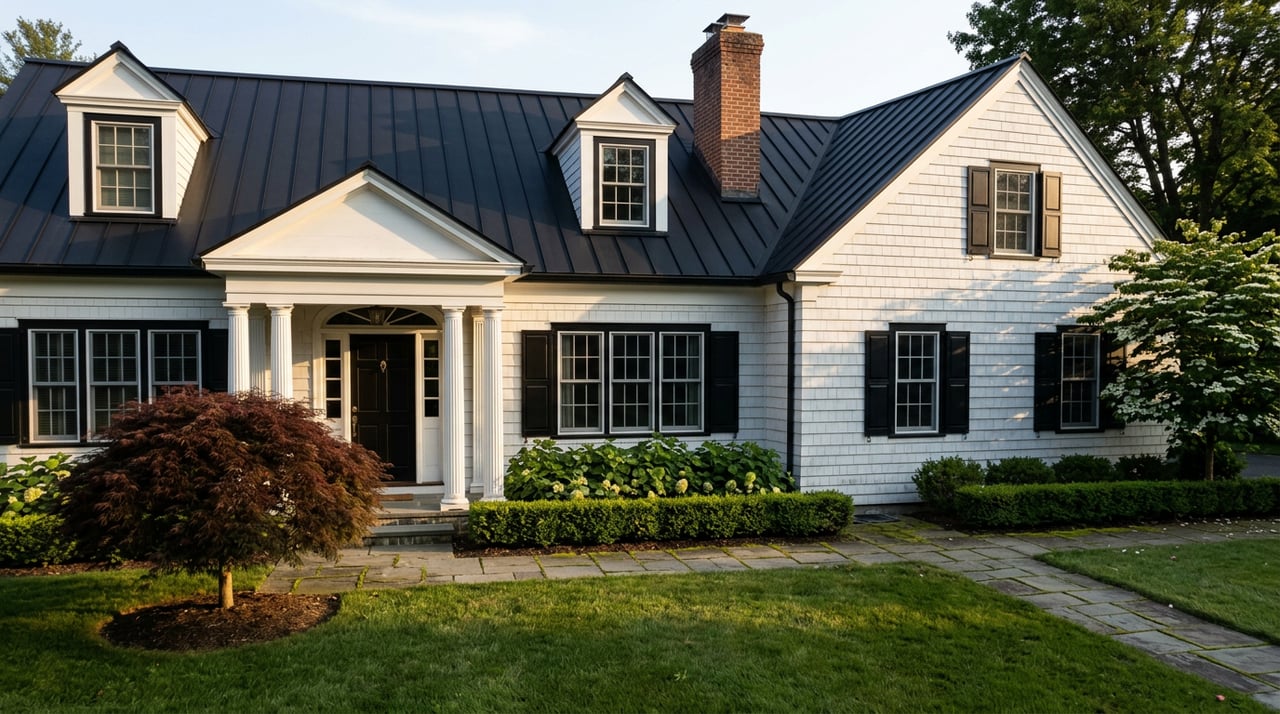
Chestnut Hill Taxes and Schools: Newton vs Brookline
Two houses sit four streets apart in Chestnut Hill. Both carry the same 02467 zip code. Both show up in the same portal search, under the same neighborhood name, with the same tree-lined feel and the same proximity to The Street at Chestnut Hill. One of them sends its property tax check to Newton City Hall. The other sends its check to the Town of Brookline. One family's kids are assigned through Newton Public Schools toward Newton South High School. The other family's kids attend a Brookline elementary school like Baker or Hayes, inside a district Newton has no authority over. Neither address gives any hint of this. The zip code is identical. The reality underneath it is not.
Buyers comparing Chestnut Hill to Newton Centre, Waban, or straight-up Brookline tend to treat the neighborhood as one market with one tax rate and one school pipeline. It isn't. And the part that actually changes your offer strategy isn't the school split, real as it is. It's that the town with the lower headline tax rate can produce the higher actual bill, depending on one box you check on a form.
Chestnut Hill was never incorporated as its own town. It's a village name laid over parts of three separate municipalities: the city of Newton in Middlesex County, the town of Brookline in Norfolk County, and sections of Boston's Brighton and West Roxbury neighborhoods in Suffolk County. The Hammond family settled the Newton portion in the 1660s, and the area stayed mostly farmland until the Chestnut Hill Reservoir was developed in 1870 by Frederick Law Olmsted, the same landscape architect behind Central Park and Boston's Emerald Necklace. The town lines that split the village today predate almost everything you'd recognize there now, including Boston College, the reservoir walking paths at Hammond Pond Reservation, and the retail corridor along Route 9.
None of that history shows up on a listing sheet. What matters for a buyer is that the boundary is real, it's old, and it doesn't track with how the neighborhood markets itself. A house can be described as Chestnut Hill in every piece of marketing material and still be, on the county recorder's books, a Newton parcel, a Brookline parcel, or a Boston parcel, each with its own tax formula and its own school district.
If schools are part of your decision, the zip code is the wrong place to look. Newton's side of Chestnut Hill routes through Newton Public Schools, which assigns elementary buildings by street address and feeds into Newton South High School, one of the state's higher-ranked public high schools. Brookline runs its own separately administered district. Several elementary schools carrying 02467 mailing addresses, including Baker and Hayes, sit entirely inside Brookline's system, not Newton's.
The confusion is common enough that it trips up buyers who never think to question it. A house with a Chestnut Hill address does not tell you which town's schools apply, and a real estate listing has no obligation to spell it out. Confirming this means checking the parcel against the actual municipal boundary, not the mailing address, before you get attached to a specific house.
Here's where it gets interesting. For fiscal year 2026, Newton's residential property tax rate is $9.69 per $1,000 of assessed value. Brookline's is $10.24 per $1,000. On the surface, Newton looks like the cheaper side of the line, and most comparisons stop right there.
They shouldn't, because Newton has never adopted a residential exemption for owner-occupants, while Brookline has. Under the Massachusetts law that allows it, Brookline's FY2026 exemption subtracts $354,974 from a qualifying owner-occupant's assessed value before the tax is calculated, which works out to roughly $3,635 in annual savings for anyone who lives in the home as their primary residence. Newton offers targeted relief for seniors, veterans, and a few other categories, but nothing close to a broad owner-occupant exemption.
Here's what that does to two otherwise identical Chestnut Hill homes, each assessed at $2,000,000:
| Newton side | Brookline side | |
|---|---|---|
| FY2026 residential rate | $9.69 / $1,000 | $10.24 / $1,000 |
| Owner-occupant exemption | None | $354,974 off assessed value |
| Annual bill, owner-occupant | $19,380 | $16,845 |
| Annual bill, non-owner-occupant | $19,380 | $20,480 |
If you're planning to live in the house, the Brookline side comes out roughly $2,535 cheaper per year than the Newton side, despite carrying the higher advertised rate. If you're buying as an investor, a second home, or anything other than a primary residence, that math flips. Brookline's exemption doesn't apply to you, so you pay the full $10.24 rate with nothing subtracted, and the Newton side becomes the better deal by about $1,100 a year.
The rate on its own tells you almost nothing. What tells you something is the rate combined with how you plan to occupy the house, and that's the number almost nobody runs before they write an offer.
A quoted tax bill on a listing usually reflects the current owner's situation, not yours. If the current owner has Brookline's exemption and you won't qualify because you're buying as an investment property, your bill will be higher than what's printed. If the current owner is an investor paying full freight and you're moving in as your primary residence, your bill could come in lower once you file for the exemption yourself. Either way, the number on the listing is a starting point, not an answer.
Before you get attached to a specific Chestnut Hill address, confirm three things: which municipality the parcel is actually in, which school district it's assigned to, and whether the tax figure you're looking at reflects an owner-occupant exemption that may or may not carry over to you. Newton's assessing department and Brookline's Board of Assessors both publish current rate information directly, and pulling the parcel record yourself takes less time than falling for a listing description that never mentions which side of the line you're on.
Does the 02467 zip code tell me which town I'm buying in? No. The zip code covers parts of Newton, Brookline, and sections of Boston. Only the parcel's actual municipal boundary determines your tax rate, your school assignment, and which town's assessor you deal with.
Is Brookline's residential exemption automatic? No. You have to apply and certify that the home is your primary residence. It doesn't apply to investment properties, second homes, or any property where the owner doesn't live there full time.
If the Brookline side saves owner-occupants money, does that mean it's always the better buy in Chestnut Hill? Not necessarily. The tax math favors owner-occupants on the Brookline side and favors non-owner-occupants on the Newton side, at comparable assessed values. Which one wins for you depends on how you plan to hold the property, and that's before factoring in school assignment, lot size, and the specific home itself.
Chestnut Hill rewards buyers who ask the second question instead of stopping at the first one. If you're comparing sides of this line, or comparing Chestnut Hill against Newton Centre, Waban, or Brookline more broadly, the numbers change depending on details a portal listing will never surface. Valerie Wastcoat works these parcels street by street. Request a complimentary home valuation and get a straight answer on which side of the line a specific address actually sits on, before you write the offer instead of after.
If you’re looking for a dynamic approach to real estate from a top-performing, knowledgeable agent who truly goes above and beyond for clients, look no further. I will work side by side with you, navigating current market conditions and guiding you every step of the way.